I think one of the strangest things about Hair is that it is a musical that seems almost obsessed with the body while also insisting that the body is not superficial at all.
Usually, when I hear a phrase like Buchen’s claim that “the message or massage of Hair is that the body is the soul,” my immediate reaction is to separate those two things. The body feels physical and temporary. It gets tired, sick, hungry, attracted to people, overstimulated, intoxicated, and eventually dies. The soul, on the other hand, is supposed to be the deeper part of us. It is supposed to be who we “really” are underneath all of that. But Hair does not seem interested in separating the two.
If anything, the musical keeps suggesting that the body is exactly where identity, freedom, politics, intimacy, and even spirituality happen. The more I thought about “Hair,” “Walking in Space,” and “Easy to Be Hard,” the more I realized that the body in this musical is never just a body. It is always communicating something, and sometimes, it is communicating something whether society wants it to or not.
I think “Hair” is probably the most obvious example of this, which almost made me overlook how interesting it actually is. It is literally a song about hair, which sounds incredibly unserious, and yet, the entire song turns hair into a political statement. The characters do not treat their hair as some meaningless cosmetic choice. Their hair becomes a declaration of freedom, individuality, and belonging. It is one of the first things other people see when they look at them, and because of that, it becomes one of the easiest things society can judge. That is what makes the song so fascinating to me. Hair is part of the body, but it is also one of the parts of the body we can manipulate most visibly. We can cut it, grow it, shave it, style it, dye it, or refuse to change it, and suddenly something as biologically ordinary as hair becomes a way of telling the world who we are.
In Hair, long hair on these men is not politically neutral. It challenges what men are supposed to look like. It challenges conventional masculinity. It challenges the assumption that a respectable person has to present their body in a certain way. What I like about the song is that the characters do not seem embarrassed about any of that. They are almost aggressively joyful about it, and I think that is exactly where Buchen’s statement starts to make sense to me. If the body is the soul, then controlling someone’s body also means controlling how they are allowed to express themselves. If you believe in freedom, the characters seem to suggest, then freedom should actually be visible.
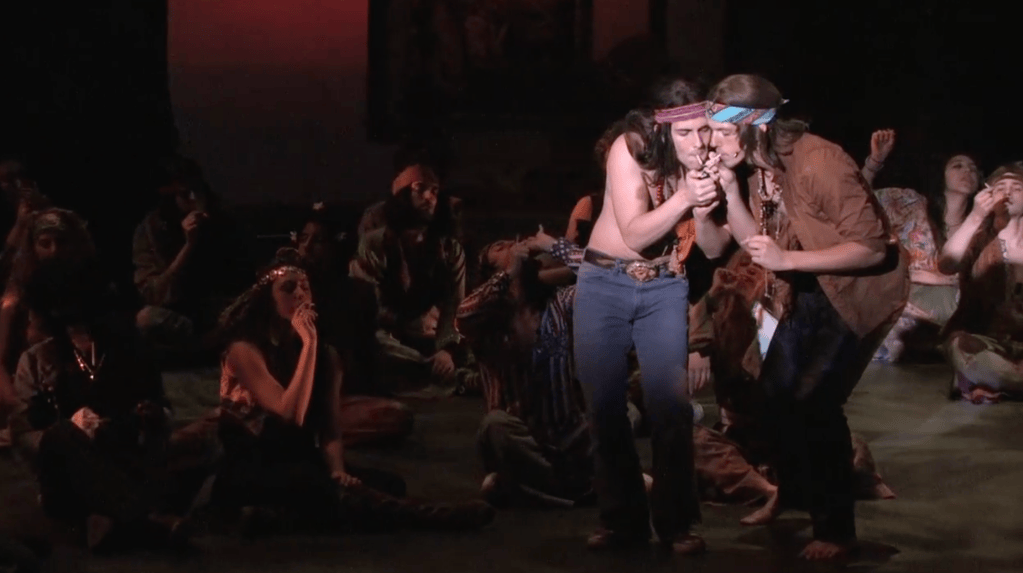
I think “Walking in Space” takes that same idea somewhere completely different. This song is obviously connected to drugs, but what interests me is that the drug experience is described so physically.
The characters feel different. They feel weightless. They feel as though they are floating. Their perception of their own bodies changes, and because of that, their perception of the entire world changes too.
I expected a song about drugs in Hair to feel more openly rebellious. Instead, “Walking in Space” feels almost spiritual to me. The song is dreamy and suspended in a way that makes the characters seem as though they are temporarily escaping ordinary physical boundaries. They are still inside their bodies, but those bodies suddenly feel less fixed. The line between the internal self and the external world starts to blur, and I think that especially matters in a musical that is constantly suspicious of boundaries.
The characters resist boundaries between men and women, between acceptable and unacceptable appearances, and between one individual and another. “Walking in Space” makes it so the characters alter their bodies, and that altered physical state becomes something almost transcendent.
I do not think the musical treats drugs as simply “good,” and I do not think the point is just that getting high equals freedom. What interests me more is that the song treats control over one’s own physical experience as meaningful. In a world where bodies are constantly being disciplined and judged, choosing what happens to your own body becomes political.
That idea becomes much more uncomfortable for me when I get to “Easy to Be Hard.” Out of these three songs, I think this one complicates Hair the most. The musical spends so much time celebrating love and peace, which sound beautiful, but “Easy to Be Hard” basically asks what any of those beliefs actually mean if you cannot care about the individual person standing directly in front of you.
To me, I feel that it is easy to care about “humanity,” but it is much harder to care about an actual human being. You can care about justice while being cruel to somebody in your own life. You can care about peace while treating people harshly. You can care deeply about suffering somewhere far away while ignoring someone who is hurting right next to you.
I think that is what makes “Easy to Be Hard” so important in a show like Hair. Without it, I think the musical could almost become too satisfied with its own ideals. The Tribe believes in love and liberation, so it would be very easy for the show to simply present them as morally superior, but this song turns the criticism back onto them. If you claim to love everyone, what does that mean if you cannot love one person well?


Leave a comment