I think Assassins might be one of the most American musicals I have ever watched, and I am still not completely sure whether I mean that as a compliment.
Before watching the full production, I already found the music fascinating, especially songs like “Another National Anthem” and “The Ballad of Czolgosz.” However, I think listening to the songs by themselves made it much easier for me to keep the assassins at a distance. They were historical figures. They were murderers, attempted murderers, extremists, and, in some cases, people who were clearly deeply unstable. I could analyze what they represented without ever really having to confront them as actual people.
However, watching the 2017 production completely changed that for me. What disturbed me most and what I didn’t expect was that I suddenly sympathized with these people and that I understood them much more than I wanted to.
There is obviously a huge difference between understanding someone and excusing them, and I think Assassins deliberately forces that distinction onto the audience. I do not walk away from the musical thinking John Wilkes Booth or Charles Guiteau or Leon Czolgosz was somehow justified. I absolutely do not. But I do walk away recognizing the incredibly ordinary feelings that they felt like loneliness, jealousy, disappointment, insecurity, frustration, and, above all, the desire to matter. And I think that is much scarier.
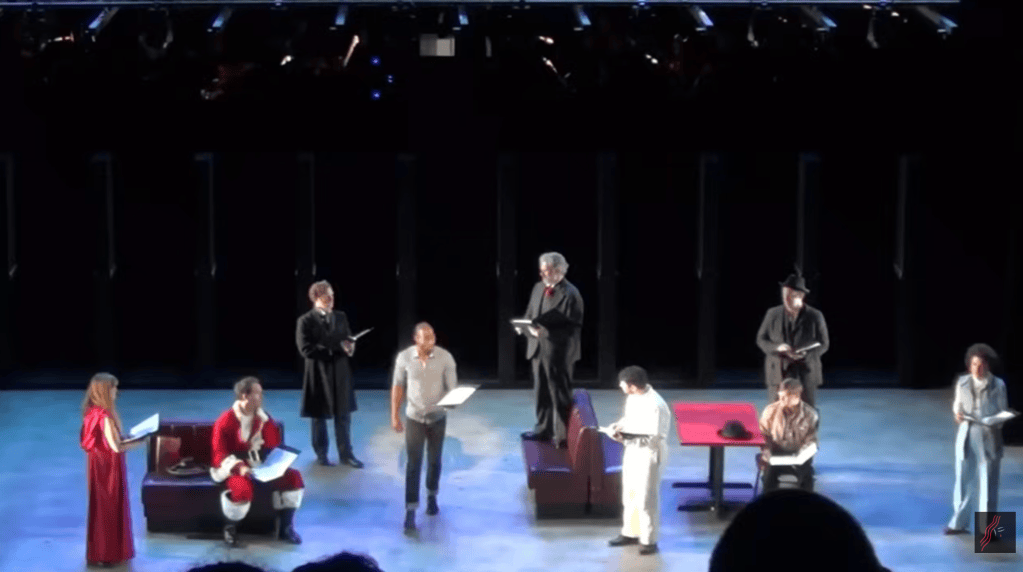
The first thing I noticed while watching the full production was how funny the show actually is. I knew there were comedic moments from listening to the soundtrack, but seeing the actors interact made those moments so much more ridiculous. Sara Jane Moore, in particular, almost feels like she wandered into the wrong musical. Her interactions with Squeaky Fromme are so bizarre that I sometimes forgot I was watching two women who attempted to assassinate the President of the United States.
Victoria Clark’s performance makes Moore feel scattered, awkward, and almost harmless at times. Meanwhile, Alex Brightman’s Zangara is so intense about his stomach pain that his frustration can become almost comical. Guiteau is theatrical and absurd. Hinckley often comes across less like an intimidating political extremist and more like an incredibly lonely young man.
And then I would find myself laughing.
That feeling became one of the most interesting parts of the entire show for me. Assassins constantly makes me comfortable with these characters and then reminds me exactly who they are. The comedy paired hand-in-hand with violence. If anything, I think it makes the violence worse because it ruins the idea that people who commit horrible acts must somehow be completely alien and unrecognizable to us.
I felt this most strongly with Czolgosz. Out of everyone in the musical, I probably found him the easiest to sympathize with politically. In “The Ballad of Czolgosz,” we hear about exploitation, dangerous working conditions, brutal labor, enormous wealth inequality, and a man becoming increasingly convinced that the entire system is fundamentally unjust. None of those complaints are particularly difficult for me to understand. In fact, many of them still sound incredibly familiar today.
That does not make assassinating President McKinley acceptable.
But that is exactly where the show makes things uncomfortable. If every one of Czolgosz’s beliefs were obviously ridiculous, I could dismiss him immediately. Instead, Sondheim gives him legitimate grievances and then shows what happens when legitimate grievances become attached to an illegitimate solution.
I think the same idea appears throughout the entire musical. These people are rarely completely wrong about what hurts them. They are wrong about what they believe they are entitled to do because of that hurt.
This is why “Another National Anthem” became even more interesting to me after seeing it performed. When we listened to it in class, I already saw it as a confrontation between two versions of America. The Balladeer represents this almost traditional American belief that if you keep working, keep trying, and remain hopeful, things will eventually improve. The assassins essentially respond, “Well, what if they don’t?”
The Balladeer keeps trying to preserve this optimistic narrative about America, while the assassins keep interrupting him with their own experiences of disappointment. And what makes the scene interesting to me is that I do not think either side is completely meaningless. I understand why the American Dream is appealing. I actually think there is something valuable about believing that your circumstances can improve and that you can build something better for yourself. But Assassins made me question what happens when that belief turns into expectation. There is a massive difference between believing, “I have the right to pursue happiness,” and believing, “I have the right to be happy.”
The Proprietor begins the show by telling these characters that “Everybody’s got the right to be happy.” At first, the line almost sounds uplifting. By the end of the musical, I found it horrifying. Each assassin has taken some version of that idea and turned it into a personal contract with America. Booth wants importance. Hinckley wants love. Guiteau wants recognition and political power. Czolgosz wants justice. Zangara wants relief from his suffering. They are all missing something, and instead of accepting that happiness was never guaranteed to them, they decide someone else must be responsible for withholding it.
That becomes especially terrifying during the scene with Booth and Lee Harvey Oswald.
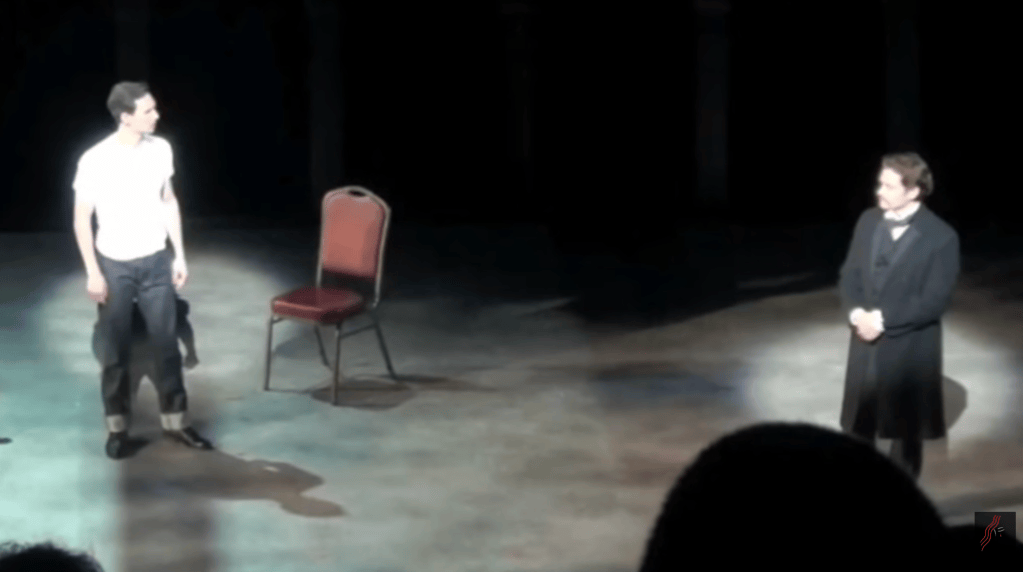
I think this was probably the scene that affected me most in the entire production. Booth does not simply tell Oswald to kill Kennedy. He gives him a reason to believe that killing Kennedy will finally make his life significant. Oswald is presented as someone who feels invisible and completely unimportant. Booth understands and validates that, and he fully appeals to Oswald’s ego and his desperation to matter.
That bothered me because I think the desire underneath it is so universally understandable. I think almost everyone wants their life to matter somehow. I certainly do. I want to feel like the things I do have meaning. I want to be successful. I want to contribute something. I want people I care about to remember me. Obviously, I do not want to achieve that by murdering somebody.
That is why I cannot call the musical completely pessimistic about America, even though it is definitely one of the harshest critiques of America I have seen. I do not think Sondheim is saying that the American Dream is worthless and should be thrown away entirely. I think he is questioning what we have done to it.
The assassins take the promise of opportunity and transform it into a promise of outcome. If I work, I deserve success. If I love someone, I deserve their love in return. If I suffer, somebody must be guilty. That is where the American Dream becomes dangerous.
After watching the full production, I think Assassins is ultimately pessimistic about the way Americans understand happiness, but not necessarily pessimistic about America itself. The musical clearly exposes inequality, loneliness, political anger, and the desperate need to be noticed. Yet I do not think its message is simply “America is terrible.” If anything, I think it asks, “can we believe in America without believing America owes every one of us everything we want?”
I still do not know exactly where I land on that question. What I do know is that I expected a musical about presidential assassins to make me think about violence and politics. I did not expect it to make me think so much about disappointment. And I definitely did not expect to see so much of ordinary human insecurity reflected back at me through some of the most infamous people in American history.
 Jing Wang's Blogs
Leave a comment